Does Paying Off Your Mortgage Change Your FIRE Number? (Most Calculators Say No — They're Wrong)
If you've ever plugged your numbers into a FIRE calculator, you've probably seen some version of the same formula: multiply your annual expenses by 25, and that's your number. Save and invest until your portfolio hits it, and you're financially independent.
It's a genuinely useful rule of thumb. It's also built on an assumption that quietly breaks for a huge share of the people using it: that your annual expenses stay exactly the same, forever.
For anyone with a mortgage, that's not true. Your mortgage payment is — for most households — the single largest line item in your budget, and at some point it goes to zero. A calculator that doesn't know that is solving the wrong problem.
The 25x Rule Assumes Your Expenses Never Change
The "25x expenses" shortcut comes from safe withdrawal rate research — most famously the Trinity Study — which asked a narrower question than most people realize: if you withdraw a fixed percentage of a portfolio every year, adjusted only for inflation, how often does the money last 30 years? The 4% figure that fell out of that research is where "multiply by 25" comes from.
That's a reasonable model for a retiree whose spending really is flat in real terms. It's a poor model for someone whose biggest expense is scheduled to disappear on a known date.
Picture two people with identical income, identical savings rate, and identical €4,000/month in expenses today. One rents. The other has a mortgage with 8 years left on it, at €1,400/month. A standard calculator treats them identically — same 25x target, same projected date. But the homeowner's real expenses in year 9 of retirement are meaningfully lower than in year 1. Their number should reflect that. Almost no calculator lets it.
What Actually Happens the Month Your Mortgage Ends
Two things happen at once, and both work in your favor:
- Your required expenses drop. If your mortgage was €1,400/month, your realistic "cost of living" in retirement just fell by that much, permanently.
- Your savings capacity rises, before retirement. Every month you're still working after the mortgage is paid off, that same €1,400 is now available to invest instead of being spent on debt service.
A flat 25x calculation captures neither effect. It either overstates how much portfolio you need (because it assumes you'll keep spending on a mortgage you won't have), or — just as often — it doesn't get revisited at all once the loan is gone, so the plan never catches up to reality.
For anyone with a significant loan mid-payoff — a mortgage, a car loan, a business loan — this isn't a rounding error. It can move your real retirement date by years in either direction, depending on where the loan sits in your timeline.
A Worked Example: Two FIRE Dates for the Same Person
Say your expenses are €48,000/year today, including €16,800/year (€1,400/month) in mortgage payments, with 8 years left on the loan. Standard 25x math says you need €1,200,000.
But once you account for the loan actually ending in year 8:
- From year 9 onward, your real annual need drops to roughly €31,200.
- Every month between now and the loan's payoff, you have an extra €1,400 available to invest that a static model doesn't credit you for.
Run the numbers properly — simulating the actual payoff month, the lower post-mortgage spending, and the freed-up savings along the way — and it's entirely plausible your realistic financial independence date lands one to three years earlier than the textbook 25x crossing suggests. Not because you found extra money, but because the standard formula was quietly overstating what you'll need for a chunk of your retirement.
The reverse is just as real: if you're early in a 30-year mortgage, a calculator that ignores your loan schedule entirely can understate how long you'll be carrying that payment, giving you false confidence.
Either way, the point stands: a FIRE number that doesn't know about your loans isn't really your number.
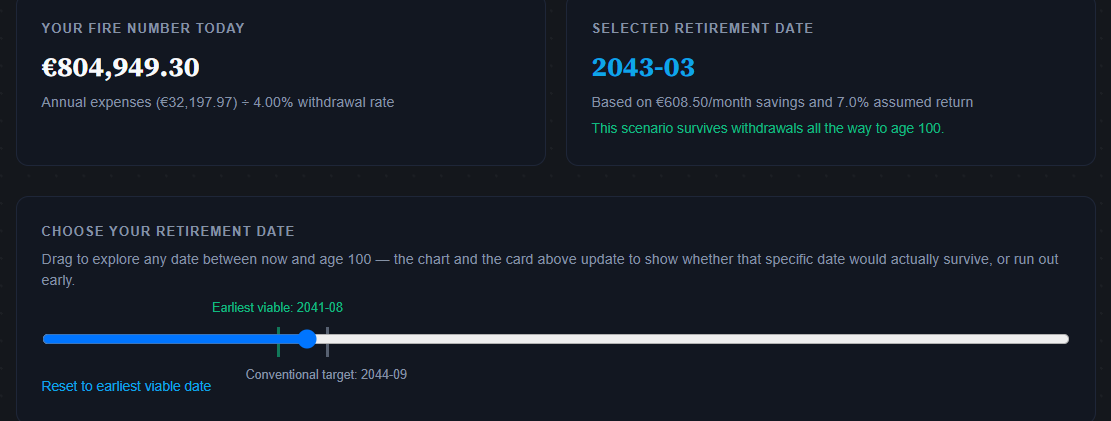 Same income, same savings rate, same expenses today — the only difference is whether the mortgage payoff schedule is factored into the calculation.
How FiscoTrail Handles This Differently
This is the exact gap the FiscoTrail FIRE Planner was built to close, using your actual loan data instead of a flat expense assumption.
Instead of giving you one static target, it computes two reference dates and lets you explore the entire range between them:
- Conventional target — the standard 25x-expenses crossing, calculated the traditional way, so you always have that familiar benchmark to compare against.
- Earliest viable date — a genuine survival simulation. For every candidate retirement month, FiscoTrail asks: if you actually stopped working right here, factoring in your real loan payoff schedule and continuing to draw down through age 100, would the money last? Once a loan finishes partway through the simulation, its payment drops out of your required expenses automatically, exactly like it would in real life.
Because the freed-up loan payment both lowers what you need and increases what you can save beforehand, the earliest viable date can land meaningfully earlier than the conventional one — but only when the math actually supports it, never as a guess. (We deliberately call it "earliest viable," not "earliest safe" — it's a simulation result, not a guarantee.)
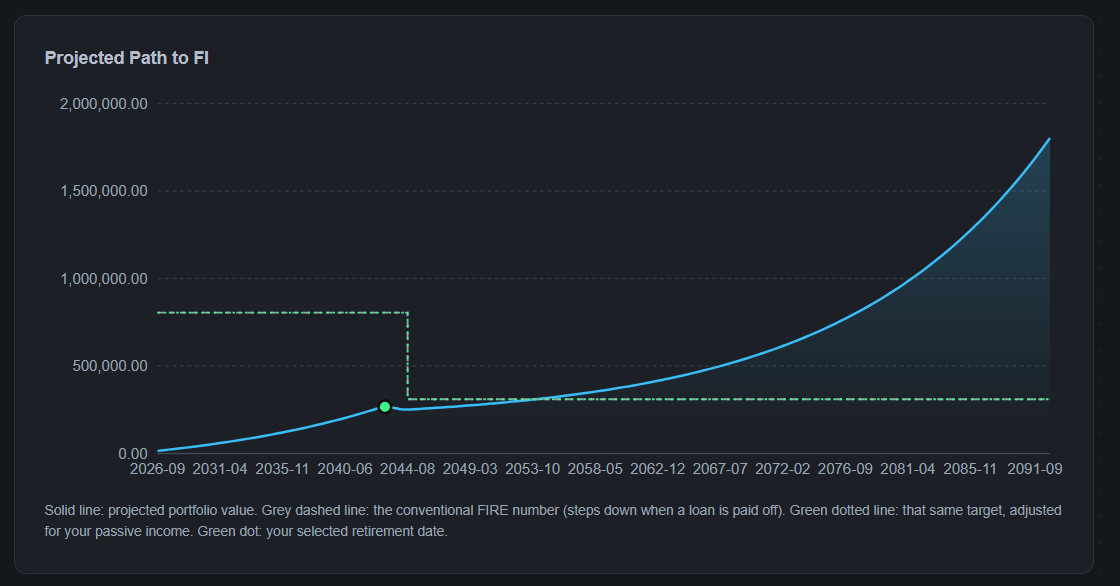 Illustrative example with made-up numbers. Both target lines step down the moment the mortgage is paid off in year 8 — which is exactly why the earliest viable date lands ahead of the conventional 25x crossing here.
You can drag a slider anywhere between those two markers — or beyond them, out to age 100 — and watch that exact scenario play out. Pick a date that's genuinely too early, and the chart shows you a portfolio running to zero, with a red marker exactly when. No guesswork, no separate spreadsheet.
For the deeper question — what if the market doesn't cooperate? — FiscoTrail also runs a Monte Carlo simulation of several thousand possible post-retirement sequences around your assumed return, so you can see the realistic spread of outcomes, not just one optimistic line.
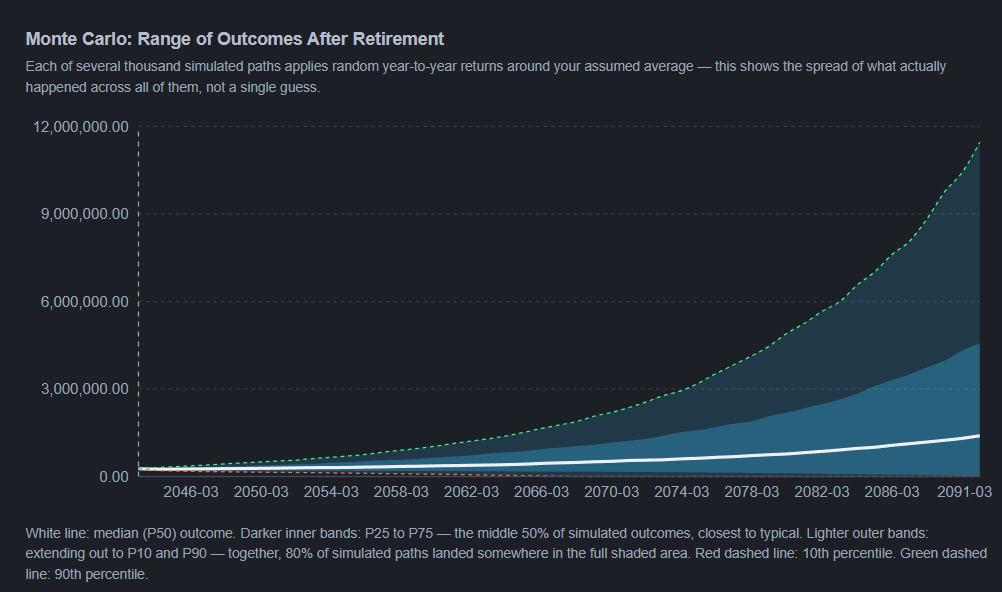 Illustrative example with made-up numbers. The darker band is the middle 50% of simulated outcomes, the lighter band the middle 80% — a quick visual read on how much a "typical" retirement can still vary.
None of this is investment advice, and FiscoTrail is upfront about that everywhere the planner appears. It's a sandbox built on your real numbers, not a recommendation engine.
This Isn't Just About Mortgages
Everything above applies to any loan with a defined payoff schedule — a car loan, a personal loan, a business loan you're carrying alongside your regular savings. If you have more than one, the effect compounds: each payoff date is a small step-down in required expenses and a small step-up in available savings, and a plan that's blind to all of them is blind to the actual shape of your financial life.
It's also worth knowing that FiscoTrail treats loan payments differently depending on which report you're looking at — only the interest portion counts as a true expense on your Income Statement, while the full payment counts on your Cash Flow Statement, since that's the actual cash leaving your accounts. The FIRE Planner's expense baseline is built on top of that same correct split, not a separate, simpler estimate.
Try It With Your Own Numbers
If you've been using a generic FIRE calculator and have a mortgage or other loan mid-payoff, it's worth re-running your number with that schedule actually factored in — the gap between the textbook answer and your real one might be bigger than you think, in either direction.
FiscoTrail pulls your income, expenses, and loan payoff schedule straight from data you're already tracking — no bank connections, ever, and nothing shared with anyone else. If you're already using the app, your FIRE Planner is waiting under FIRE Planner in the sidebar. If you're not yet, you can create a free account and see your own earliest viable date in a few minutes.
Frequently asked questions
Does paying off my mortgage really change my FIRE number? Yes, if your calculation accounts for it. A mortgage payment is a temporary expense with a known end date — once it's gone, your real cost of living drops, and any FIRE number based on flat, unchanging expenses will overstate what you need for that part of your retirement.
Should I pay off my mortgage early or invest instead, to reach FIRE sooner? That depends on your interest rate, your expected investment return, and your own risk tolerance — it's a genuinely individual decision, not something a blog post can answer for you. What matters for your FIRE number specifically is making sure your payoff schedule, whichever one you choose, is actually reflected in the calculation.
Is the "earliest viable date" a guarantee I won't run out of money? No. It's the output of a simulation based on the assumptions you provide — your expenses, your loan schedule, your assumed return and withdrawal rate. Markets are unpredictable, which is exactly why running a Monte Carlo simulation alongside it, to see the range of realistic outcomes rather than one line, is worth doing before treating any date as final.
This article is for general educational purposes and is not financial or investment advice.